When I first saw the show “Beauty and Truth: Agnes Martin” at the Guggenheim in 2016, the entire experience was both intriguing and astonishing. I was fortunate enough to witness her major retrospective, which encompassed elements of both Minimalism and Abstract Expressionism. Last week, I had the opportunity to revisit one of her paintings, titled “Friendship,” created in 1963, and displayed in the Museum of Modern Art. This particular artwork, which I had encountered six years ago, holds a significant place in her career from the early 1960s, as it is one of three paintings in which Martin incorporated gold leaf and gesso, becoming a “hallmark” of her artistic style. Initially, upon a quick glance, I found this painting unappealing. However, after dedicating some time to closely observe and delve into its details, I came to realize that it is incredibly intricate, enchanting, and holds a spiritual essence for me.

Despite the artwork potentially being a personal and subjective creation for the artist, I found it to be profoundly spiritual. The act of crafting such a large-scale piece with delicate gold leaf required both physical and mental challenges. I could sense the artist’s unwavering dedication and discipline embedded within the work. Perhaps it was an exercise in meditation and self-determination, evident in every line she formed, every grid she constructed, every stroke she brushed, every application of gold leaf, every movement she made, and every breath she took. Interestingly, her painting may reveal themes related to “the power of individuality and the importance of nature,” concepts that hold significance in Zen Buddhism and American Transcendentalism—two of the influences mentioned in the exhibition text. Ultimately, if this artwork was not created for public appreciation, it would truly reflect her spiritual journey and intentions.
Though my work differs greatly from hers, consisting of numerous colorful shapes and complex forms, the “Friendship” we share through our creative endeavors bears similarities. We both exhibit qualities such as self-determination, creativity, process thinking, concentration, and an exploration of life’s journey. While her minimalist creations may refine one’s soul through their simplicity, my maximalist designs seek to enrich the mind through their intricacy. As artists and designers, our hope is that the impact of our work transcends boundaries and proves beneficial, to varying degrees, to the public. Above all, we create art with the intention of making our community a better place. This shared purpose forms the most precious bond of “Friendship” that we hold for the world.
Related Posts

Na Un Nong
Once certain birds leave their protective nests, they may never return, while others find it difficult to dwell without their nests and perceive the outside world as unknown, unsaf
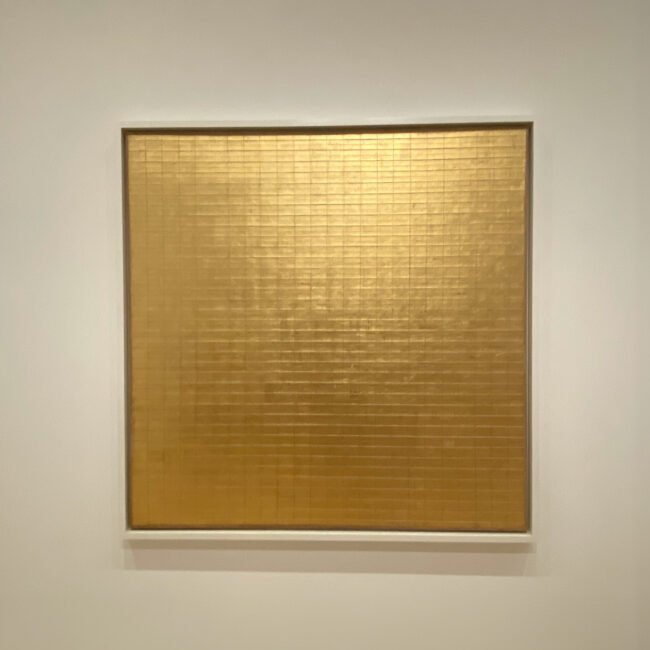
“Friendship” by Agnes Martin
This piece of writing is a review of "Friendship," a painting by Agnes Martin housed in the MoMA in New York.